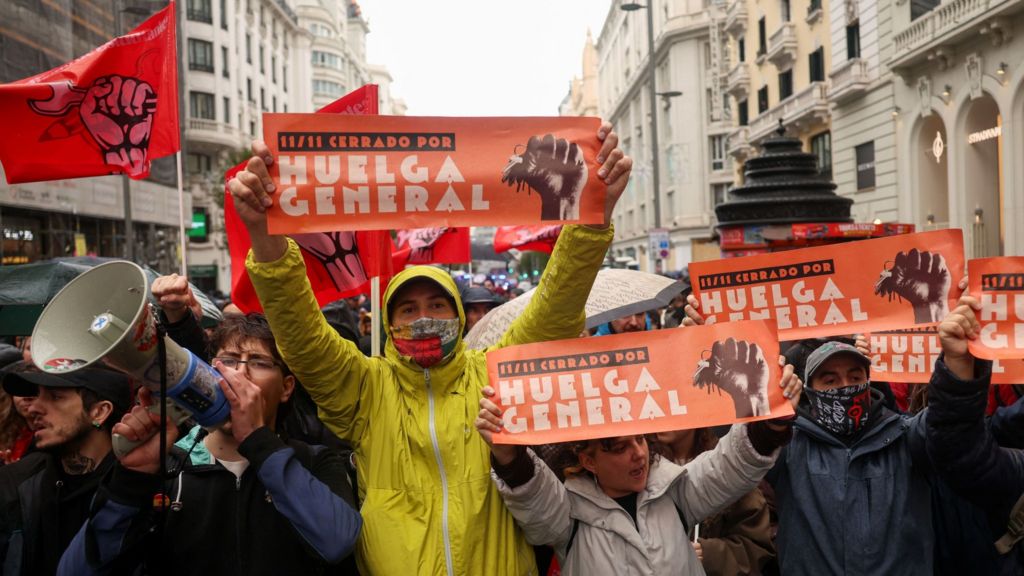
In a significant turn of events, Spain has experienced widespread disruptions as a result of the first general strike called by major unions in 14 years, aimed at addressing the escalating housing crisis and high cost of living. The strike, which took place today, was met with considerable support across the country, with the largest demonstrations anticipated in Madrid and Barcelona. The protests come less than three weeks before Spaniards are due to vote in parliamentary elections on November 29. Union leaders such as Pepe Álvarez of UGT and Unai Sordo of CC OO reported that participation was "massive" and "very significant." However, the Spanish Confederation of Business Organisations deemed participation as "low and uneven," depending on the regions and sectors involved. Some of the most substantial disruptions were observed in Madrid and Catalonia's industrial hubs, where traffic came to a halt on several major roads. The strike was instigated by widespread protests over affordable housing and increasing living costs, following the eviction of an 87-year-old woman, Maricarmen Abascal, from her home in Madrid after seven decades. The cost of renting an apartment in Madrid has surged in recent years, with the average monthly rental price for a 50m sq apartment reaching €1,170 in October, as reported by Idealista, while Spain's average gross monthly salary is approximately €2,460 (£2,056). This amounts to nearly half the average gross salary, well above the recommended 30% affordability level suggested by housing experts and public institutions.
Socialist Prime Minister Pedro Sánchez called for snap elections last month after parliament failed to approve his plan for housing reform. While previous strikes have posed problems for governing parties, this strike is unique as Sánchez and his ministers have publicly encouraged workers to participate, highlighting historical labor victories such as the eight-hour workday, pensions, and public healthcare. By contrast, the conservative People's Party (PP) has accused the government of politicizing the strike for electoral gain, with PP leader Alberto Núñez Feijóo labeling unions as "mafia" and "trash." The PP is currently leading in the polls, and party spokesman Miguel Tellado alleges that the government exploits the strike to caution voters against a right-wing government formation, which appears likely following the November 29 election.
The strikes drew participation from various sectors of society, including Gonzalo Álvarez, a 27-year-old sales representative who has been volunteering for a housing union that advocates for tenants' rights. The eviction of Maricarmen Abascal at the end of September served as the catalyst for this protest, according to Álvarez, who personally knew the elderly woman and was deeply affected by her treatment under new landlords. Álvarez and his girlfriend rent a small one-bedroom flat in Madrid's southern Arganzuela district, spending about half of their combined salaries on housing expenses before other bills. They see no way of affording homeownership with their current wages. However, Miguel Garrido, the vice-president of the CEOE, Spain's largest business association, criticized the strike, arguing that businesses have little influence over housing prices and suggesting that the early calling of elections is a primary motivation for the walkout. Demonstrations were planned in some of Spain's biggest cities later in the day, with the scale of support serving as an indicator of public discontent ahead of the election. Another reliable gauge of strike support can be found in Spain's industrial sector, where power usage fell by 7.5% during the early hours of Wednesday, according to Red Eléctrica data. During the last general strike 14 years ago, equivalent consumption was down by more than 15%.