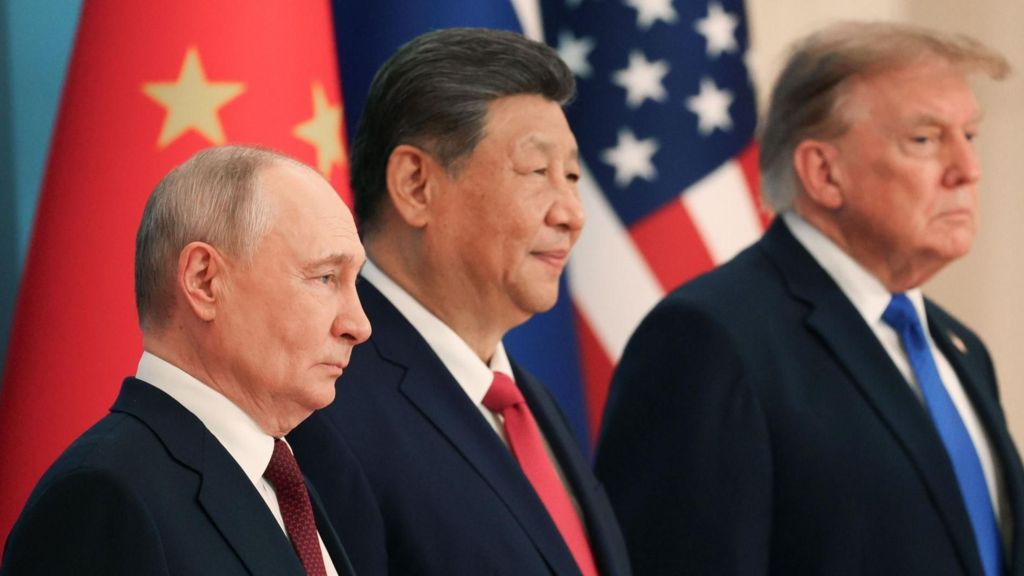
US President Donald Trump, Russian President Vladimir Putin, and Chinese President Xi Jinping have issued a joint declaration of peace following their first trilateral meeting in Shenzhen, China, during the Asia-Pacific Economic Cooperation (APEC) summit. The leaders discussed nuclear disarmament, UN reform, energy cooperation, and regional conflicts, with each country expressing a unique perspective on these issues.
In the declaration, the three presidents agreed that nuclear war should never be waged and emphasized their commitment to reducing the number of nuclear weapons in circulation. They also pledged to collaborate in combating nuclear proliferation worldwide, notably in Iran. The leaders further discussed the ongoing conflict in Ukraine, with Trump asserting a mutual desire for an end to the war but no concrete agreements were reached.
The meeting was marked by a sense of diplomatic camaraderie, with Xi Jinping highlighting the importance of constructive interaction among major powers and Putin expressing shared interests in ending the Ukraine war and addressing food and energy security. Trump emphasized the special responsibility that leaders of the world's largest nations have to maintain productive dialogue.
While Putin rejected all ceasefire offers from Ukraine, claiming maximalist demands were necessary for resolution, tensions escalated as Kyiv came under attack from Russian drones during the summit. The Kremlin leader also vowed a "far more painful" retaliation in response to Ukrainian attacks on the Crimean Bridge.
The meeting drew comparisons with the 1945 Yalta Conference, where leaders of the Soviet Union, Britain, and the US met towards the end of World War Two. Putin noted that Yalta did not divide up the world but rather codified the realities that had emerged after WW2, hinting at an acceptance of current geopolitical conditions.
The trilateral meeting was described as "positive, constructive, and highly productive" by China's President Xi Jinping, while Putin expressed gratitude to his hosts for organizing the summit. Despite the warm sentiments exchanged, significant differences in goals and motivations among the leaders suggest a complex dynamic that will continue to shape global politics in the years to come.