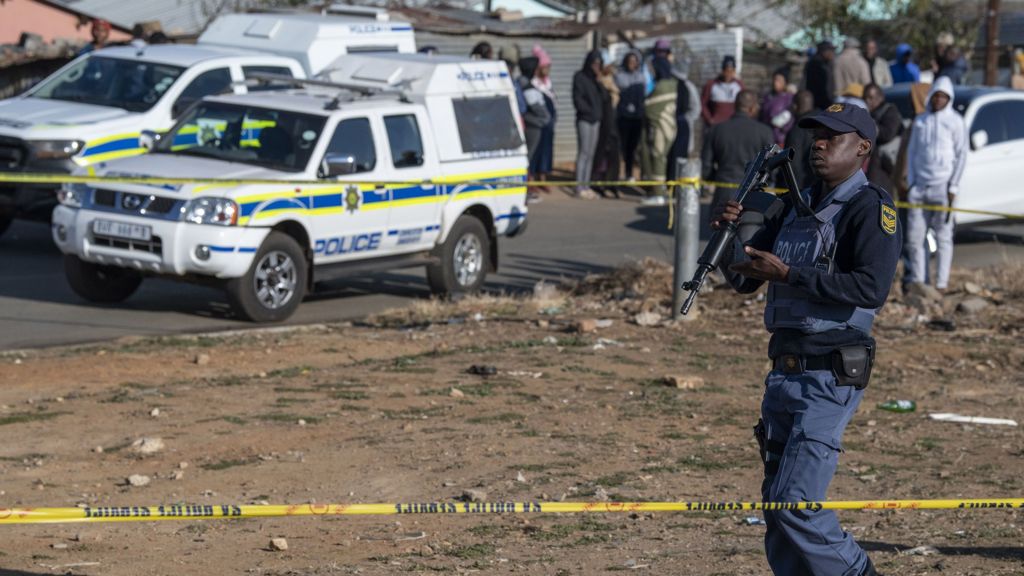
South African authorities are investigating two separate shootings that resulted in the deaths of 17 individuals across KwaZulu-Natal and Gauteng provinces on Sunday night. In the first incident, eight men were fatally shot inside a minibus in KwaZulu-Natal, while nine people were found dead in a shack in western Pretoria hours later. According to police, the two incidents are unrelated, and the motives for the shootings remain unknown. South Africa has struggled to control violent crime, with one of the world's highest murder rates. The country has seen an increase in gang-related killings and mass shootings involving illegal firearms. In a separate shooting in Jeffsville informal settlement in Atteridgeville, six men and three women were found dead inside a shack between 22:00 and 23:00 on Sunday. The police have mobilized resources to search for the suspects, and additional reporting has been conducted by BBC Africa.
In an effort to tackle armed violence, the military was deployed alongside police to five provinces with the highest murder rates earlier this year, including Gauteng. According to the latest police statistics, 5,427 people were murdered nationwide between April and June 2026, a decline of 6% compared with the same period a year earlier. President Cyril Ramaphosa has described organized crime as "the most immediate threat to our democracy, our society, and our economic development."
South African authorities are investigating the murders of 17 people in two separate shootings on Sunday night. In KwaZulu-Natal province, eight men were fatally shot in a minibus, while nine people were found dead inside a shack in western Pretoria hours later. According to police, the incidents are unrelated, and the motives for the shootings remain unknown. South Africa has struggled to contain violent crime, with one of the world's highest murder rates. The country has seen an increase in gang-related killings and mass shootings involving illegal firearms.
In a separate shooting in Jeffsville informal settlement in Atteridgeville, six men and three women were found dead inside a shack between 22:00 and 23:00 on Sunday. The police have mobilized resources to search for the suspects, and additional reporting has been conducted by BBC Africa. In an effort to tackle armed violence, the military was deployed alongside police to five provinces with the highest murder rates earlier this year, including Gauteng. According to the latest police statistics, 5,427 people were murdered nationwide between April and June 2026, a decline of 6% compared with the same period a year earlier. President Cyril Ramaphosa has described organized crime as "the most immediate threat to our democracy, our society, and our economic development."
South African authorities are investigating two separate shootings that resulted in the deaths of 17 individuals across KwaZulu-Natal and Gauteng provinces on Sunday night. In the first incident, eight men were fatally shot inside a minibus in KwaZulu-Natal, while nine people were found dead in a shack in western Pretoria hours later. According to police, the incidents are unrelated, and the motives for the shootings remain unknown. South Africa has struggled to control violent crime, with one of the world's highest murder rates. The country has seen an increase in gang-related killings and mass shootings involving illegal firearms.
In a separate shooting in Jeffsville informal settlement in Atteridgeville, six men and three women were found dead inside a shack between 22:00 and 23:00 on Sunday. The police have mobilized resources to search for the suspects, and additional reporting has been conducted by BBC Africa. In an effort to tackle armed violence, the military was deployed alongside police to five provinces with the highest murder rates earlier this year, including Gauteng. According to the latest police statistics, 5,427 people were murdered nationwide between April and June 2026, a decline of 6% compared with the same period a year earlier. President Cyril Ramaphosa has described organized crime as "the most immediate threat to our democracy, our society, and our economic development."