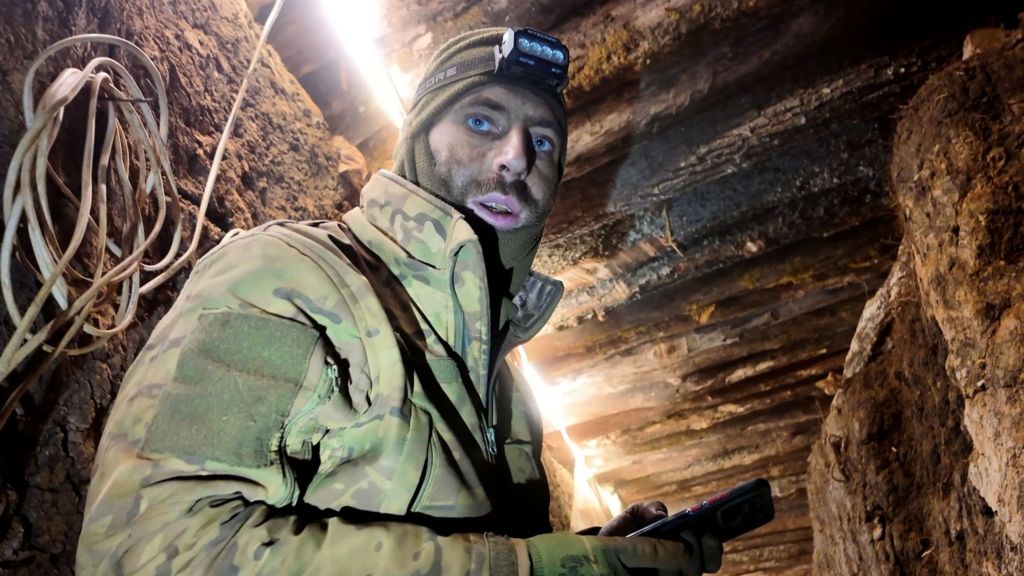
In a novel twist to the ongoing conflict, Ukrainian forces are engaging in hand-to-hand combat with Russian troops within an old Soviet gas pipeline in the Kharkiv region. The tight quarters offer relative safety from drones that dominate the skies above, making progress on the surface nearly impossible. For seven months, Ukrainian soldiers have been living and fighting underground, a "new world of warfare" as described by Zanuda, who has played a key role in planning the operation. The journey to reach this subterranean battleground is treacherous, involving long marches through muddy terrain and high-speed vehicle rides across open fields. Upon arrival, the strong odor of gas and stale air greets visitors. Both sides use openings in the pipeline to access the surface for most fighting. The Russians were the first to exploit this method during their 2025 infiltration of Kupyansk, but Ukrainian forces have since gained the upper hand. A specially designed electric cart transports troops and supplies through the pipeline, nicknamed the Kupyansk metro, though it occasionally breaks down. The destination is a break in the pipeline where Ukrainian soldiers have built dug-outs to store ammunition and equipment. Here, a soldier known as Musician coordinates the movement of troops and supplies. He has been living underground for three months, with brief visits above ground for cleaning and toilet breaks. The sound of artillery rounds above can be heard occasionally. Operation Veles, named after a Slavic god of the underworld, was launched in April 2026. Since then, Ukraine has advanced 15km along the pipeline at great cost, with constant fear of encountering enemy forces. Foreign fighters, including Colombian volunteers, have helped boost Ukraine's depleted ranks, clearing debris, water, and Russian barricades inside the pipeline. The physical and psychological challenges of operating underground have tested the soldiers' limits, with some suffering abrasions, panic attacks, and breathing difficulties.
SUMMARY (CONTINUED):
Commander Biashym, a former miner, keeps in touch with his troops from a building on the surface. He also manages a cabinet full of medical supplies for the soldiers who spend much of their time on their knees in the confined space. Some soldiers have struggled psychologically with living in such close quarters, while others have faced the danger of ricocheting gunfire when advancing. Over the course of Operation Veles, Ukraine claims to have killed more than 100 Russian soldiers and taken 30 prisoners. Kort, one of the soldiers, recounts finding bodies during their advance and even sleeping next to them. The Colombian volunteers, part of the RUG 23rd Assault Regiment, have helped clear 500 meters of pipeline in 30 days, describing the process as difficult, hot, and fraught with fear. Despite these challenges, both Ukrainian forces and their foreign allies continue to push back against Russian troops in this unique subterranean battlefield.
SUMMARY (CONTINUED):
The use of underground pipelines as a warfront is not new, having been employed by both sides during previous battles, such as the capture of Avdiivka in 2024 and last year's attempt to recapture areas of Russia's Kursk region. However, Ukraine's strategic adaptation to this unconventional battlefield has allowed them to slowly turn the tables on Russian forces in the Kharkiv region. The stalemate above ground has forced both sides to rethink their strategies and adapt to the challenges presented by the subterranean environment. As the war continues, it remains to be seen how this new front will impact the broader conflict and the future of military operations in urban and confined spaces.