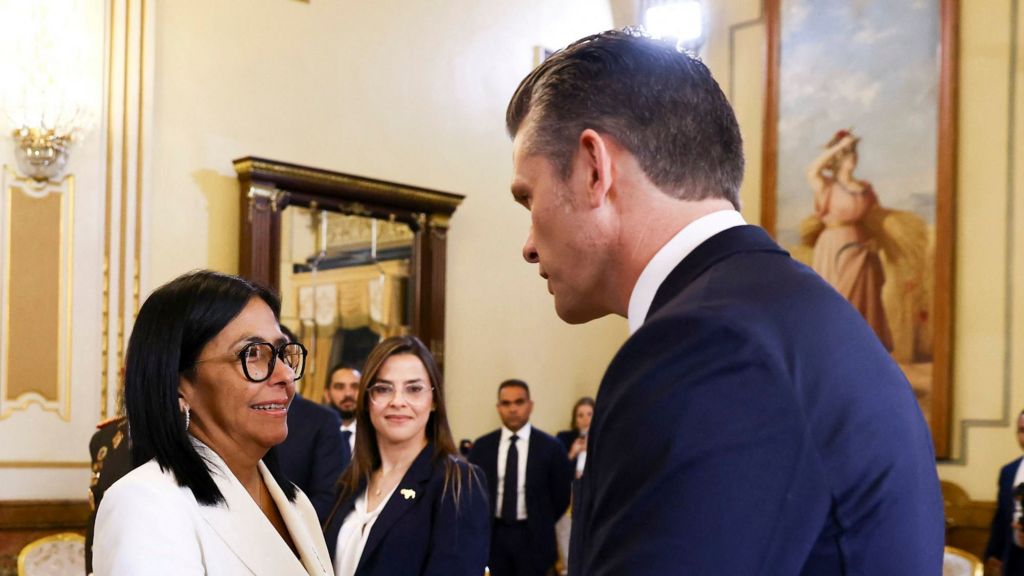
In a significant turn of events, the United States and Venezuela have rekindled their military relations after a year of strained ties, following the removal of former leader Nicolás Maduro. The interim government led by Delcy Rodríguez, Maduro's former vice-president, signed a military cooperation agreement with US Secretary of Defence Pete Hegseth on Wednesday. The deal, yet to disclose detailed terms, marks a dramatic shift in the region's geopolitical landscape, with Venezuela transitioning from a perceived threat to a cooperative security partner within 12 months. Interim President Rodríguez expressed that the agreement will aid in addressing common threats. The last time military cooperation existed between the two countries was in 2005 under Hugo Chávez's administration, when ties were severed due to allegations of disparaging remarks by US military personnel and accusations of the US military office being an organ of the CIA against the government.
The deterioration of relations continued under Maduro's rule, reaching a nadir late last year when the US offered a $50 million reward for information leading to his capture, eventually seizing him on 3 January in a military raid. Currently, Maduro and his wife, Cilia Flores, are detained in New York on charges of drug-trafficking and conspiracy to commit torture, which they deny. In his speech at the US embassy in Caracas, Hegseth acknowledged the change in the two countries' relationship since Maduro was seized, stating that "Just one year ago, my presence here, our presence here would have been deemed impossible, almost unimaginable." He emphasized that the military raid on 3 January had resulted in peace, as Maduro predicted.
The agreement signed by Hegseth and Venezuela's defence minister was described as a "new chapter" by Hegseth, while Rodríguez deemed it "extraordinarily relevant for our bilateral relations." Rodríguez mentioned training for Venezuela's armed forces, improving operational equipment, and access to new technology in her speech. In his address at the US embassy, Hegseth made clear that he considers narco-terrorists using Venezuela as a safe haven to be the threats that the deal aims to confront.
After leaving Venezuela, Hegseth travelled to Colombia, where President Abelardo de la Espriella expressed reservations about joint US-Colombian military operations against armed groups in a tweet. The US-Colombian partnership, however, remains strong according to Hegseth's response to the tweet.